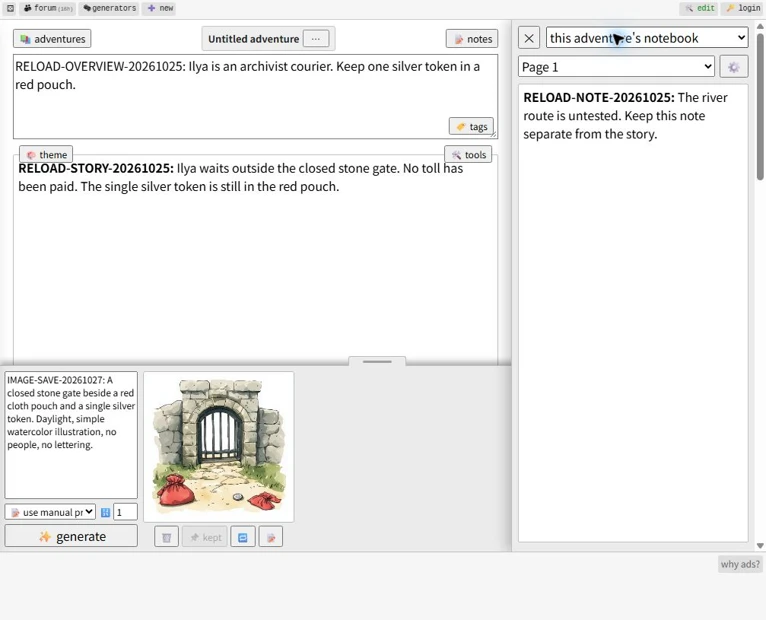
This is a same-day interface persistence test, not a test of an AI narrator remembering facts. AI Campaign Journal’s Codex operator performed the edits and reload on October 25, 2026, Beijing time. The text is a deliberately fictional fixture, not a reader’s campaign. All new commands, displayed returns and stopping points are in the public action log.
What survived the actual refresh?
| Edited area | Exact marker | After refresh | Stop |
|---|---|---|---|
| overview | RELOAD-OVERVIEW-20261025 | Same full text displayed | Read field; no continuation |
| story | RELOAD-STORY-20261025 | Same full text displayed | Read field; no continuation |
| notebook | RELOAD-NOTE-20261025 | Same full text displayed | Opened Page 1; no narrator query |
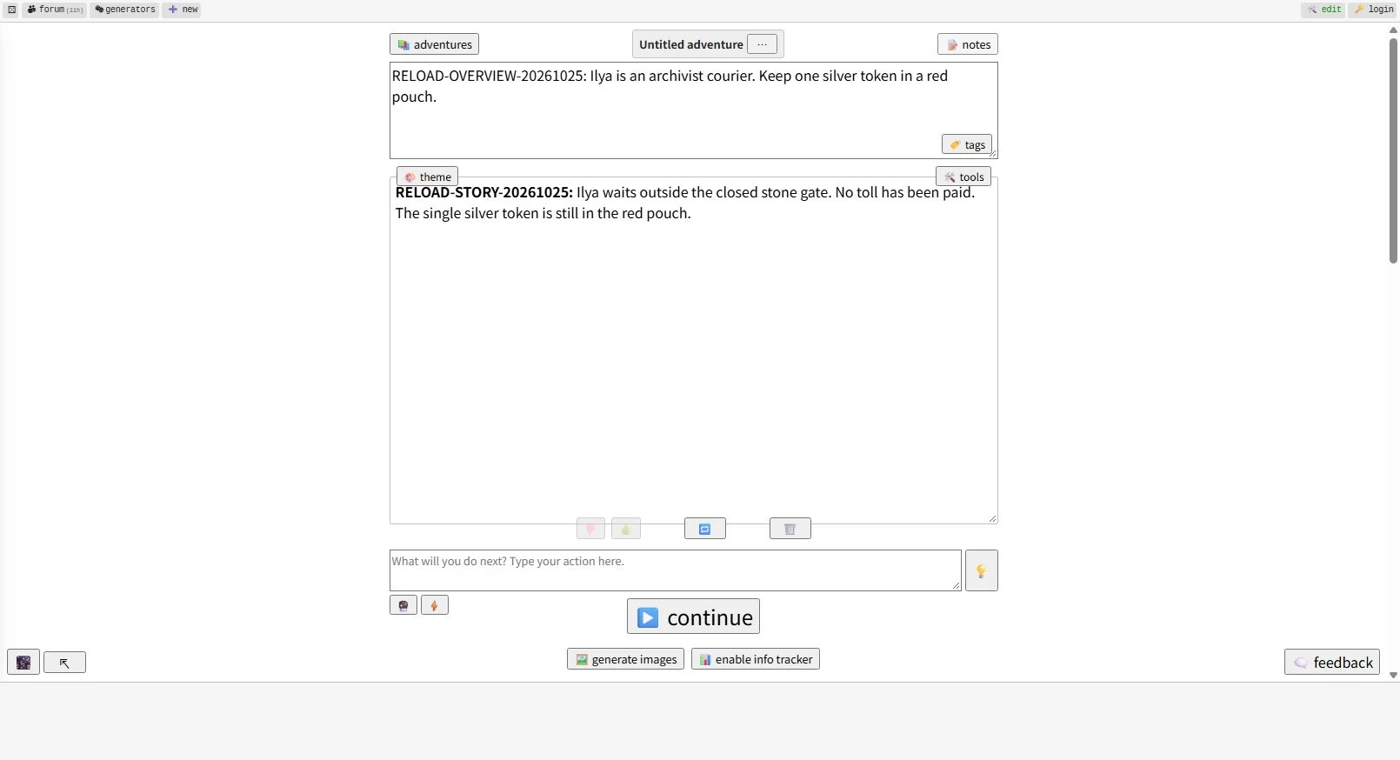
Our overview after editing began RELOAD-OVERVIEW-20261025 and identified Ilya as an archivist courier carrying one silver token in a red pouch. After the same-tab refresh, that complete sentence returned in the overview field. We checked the whole line, not just the presence of the character’s name. No downloaded backup was selected between typing this new marker and reading it back. The precise stopping point was the restored overview field; we did not ask the narrator to apply the instruction.
The separate story edit began RELOAD-STORY-20261025. Its scene left Ilya outside a closed stone gate, explicitly unpaid, with the single token still in the pouch. All three scene details and the dated marker appeared again in the story editor after refresh. They had been typed directly into the editor, not generated as a new turn. We stopped at the returned editor text. This establishes visible retention of that edit, without establishing how a later generated continuation would handle the unpaid toll.
Did the notebook survive separately from the story?
Before refreshing, we opened notes with the scope set to this adventure’s notebook and Page 1 selected. We replaced the old synthetic note with RELOAD-NOTE-20261025: The river route is untested. Keep this note separate from the story. After the game interface returned, opening notes again displayed the complete new line in Page 1. The story field still contained the gate scene rather than this note. We stopped after reading the notebook; no command asked the narrator about the river.
What happened when the page only showed a loading circle?
An earlier refresh of the old synthetic fixture initially left a loading circle where the game should appear. The overview and story were therefore unreadable at that moment; we did not log them as missing. One normal reload retry brought back the old overview and gate text, and opening notes showed its old notebook marker. Only after recovering that visible baseline did we enter today’s new markers and perform the measured refresh above. No import or generation was used to recover the baseline.
Treat a blank loading frame as an unresolved access state until the interface actually returns. The observation here is narrower than a guarantee about recovery: we saw the old fields return after a retry, then saw the new edits return after a subsequent refresh. We did not clear storage, interrupt an active generation, restart Chrome or simulate a damaged save. None of those failure cases can be inferred from this result.
Is refreshing the same as restoring a backup?
No. Our earlier native backup file inspection and visible import check concerned an exported file. Today we changed text through the running interface and refreshed without importing that file. These are different actions. Perchance’s visible help says adventures use browser/device storage and recommends regular exports. Our result is compatible with that description; it does not prove that browser storage is permanent or portable.
For reference, AI Dungeon’s settings documentation describes an adventure-text download, while FableAI’s memory guide explains narrator memory layers. Those documentation pages are not results of the same reload task on those services. We ran this task only in Perchance and make no comparative reliability ranking.
How can you check your own campaign without risking it?
Use a disposable adventure. Put distinct harmless lines in the overview, story and adventure notebook. Read them back before refreshing. After refresh, inspect each field separately and record exactly where you stop. A successful return of a notebook line answers a storage question; it does not answer whether the AI includes that notebook in its context. Keep a separate exported backup before testing anything destructive.
Before your next session, export a backup and check that your latest story line and notebook note both reappear after an ordinary refresh.