How Do You Decide Which Campaign Facts an AI RPG Generator May Change?
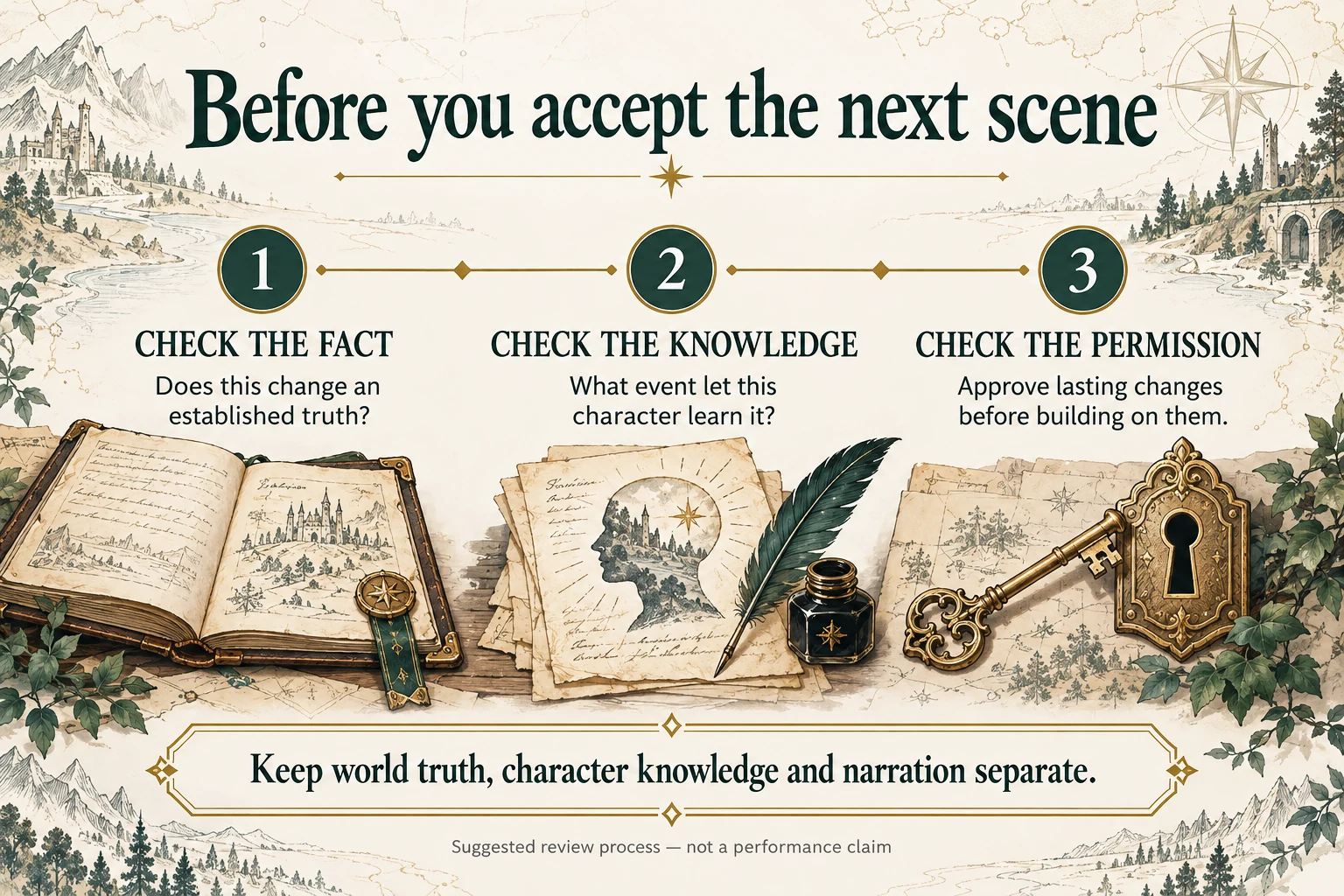
An AI RPG generator needs a clear boundary between established campaign facts and new narration. Approve changes to lasting facts separately from the prose that describes them, and keep a separate note of who knows each secret. This is a suggested workflow, not a guarantee that a model will obey it.
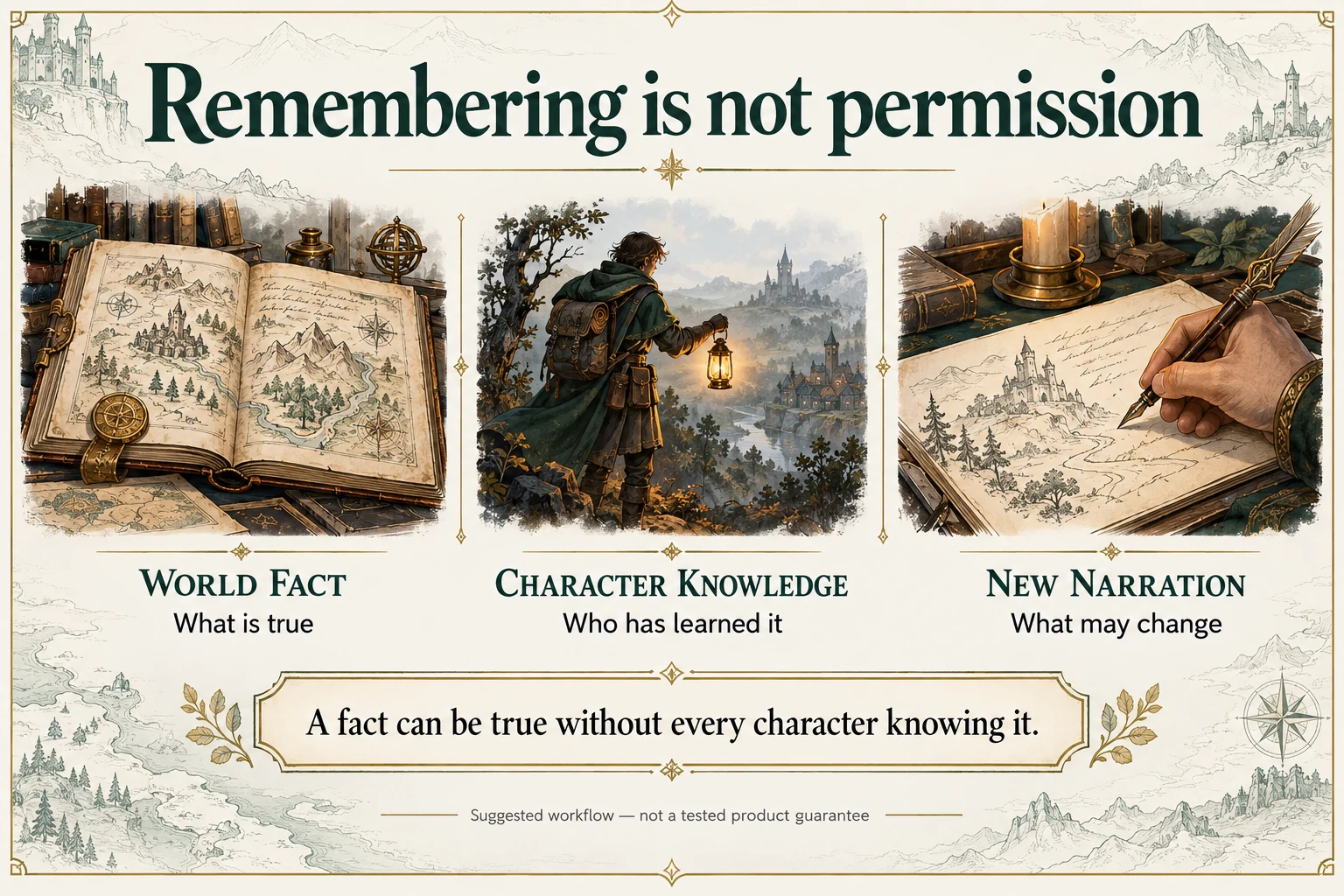
Memory and permission are different questions
Remembering a fact does not answer whether a new scene is allowed to change it. AI Dungeon documents Plot Essentials, Story Summary and keyword-triggered Story Cards. Perchance’s BlizzardUI documents field locks and pending changes that a player can accept or reject. FableAI’s memory guide recommends narrator notes for standing facts and secrets. These are existing controls, not missing features discovered by this article.
Time jumps can expose knowledge that should stay separate
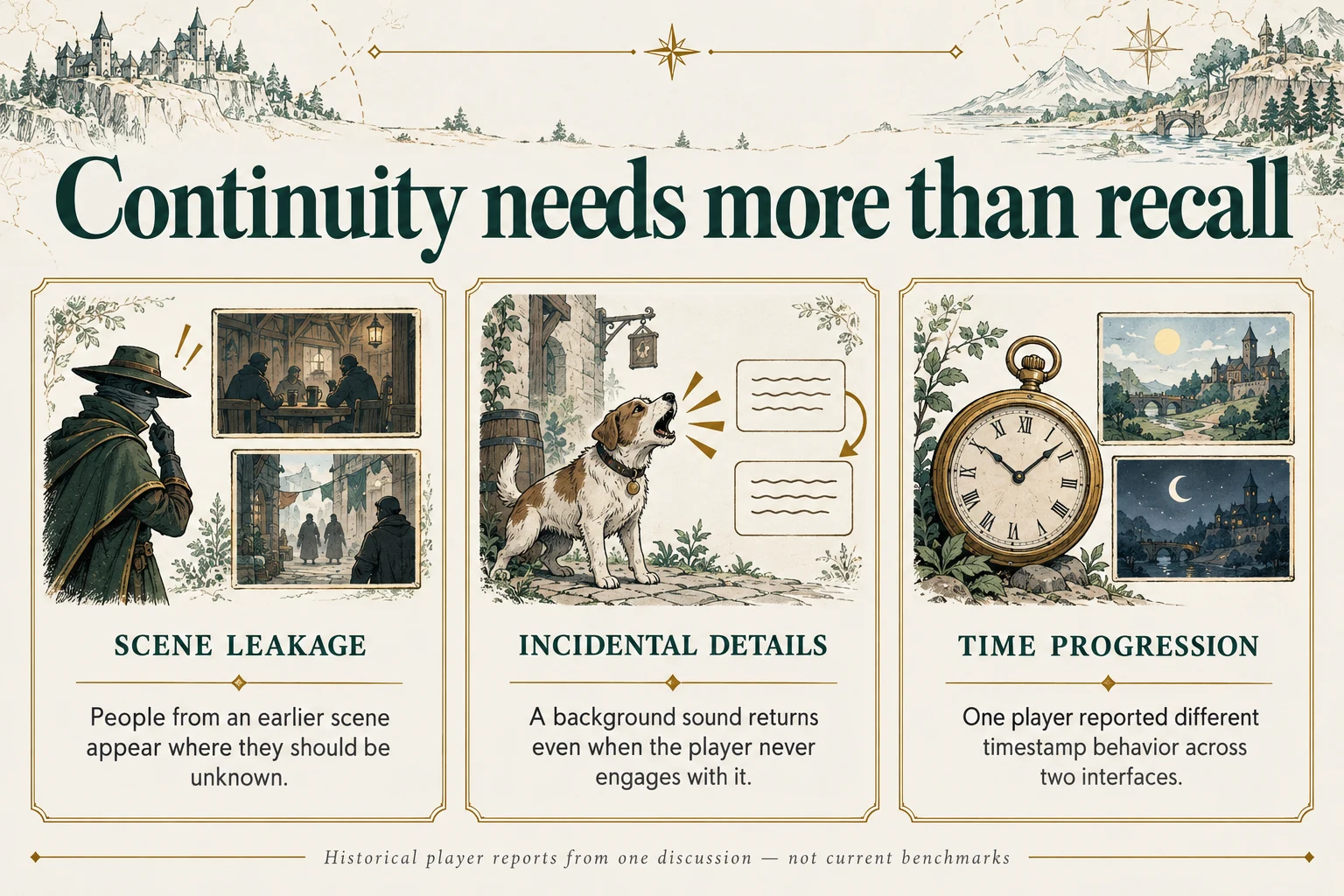
One Perchance player described switching between time periods, settings or viewpoint characters, then seeing people from the previous scene brought into the new one despite their being unknown there. The same player later described a more successful detective adventure: limited hints about a masked character’s identity prompted the AI to develop clues, including the significance of that character knowing things they should not know.
That is a historical account of contrasting sessions, not evidence of a measured upgrade. The player did not know whether a model or a backend change explained the improvement. The useful distinction is between a fact being true in the world and a character having a reason to know it.
An incidental detail need not become a permanent demand
The same player recalled an earlier adventure where a dog barking next door kept returning in every response even though the player never interacted with it. In technology-themed adventures, the player also saw side characters repeatedly report statistics after a loosely related topic appeared in the initial prompt. Another participant recalled a necklace repeatedly shimmering and a passing car repeatedly producing engine or horn sounds.
These accounts concern repeated narration, not proof that a stored field was overwritten. They suggest a separate review question: did a background detail merely exist, or did the player actually choose to make it important? Treating every remembered detail as a continuing obligation is our interpretation of the risk, not a demonstrated internal mechanism.
A fresh start did not resolve every reported problem
A dissenting player described repetition at the beginning of an adventure, with details from the preceding response already being missed. The player said stopping and starting three times did not remove the problem. In that account, fixation on objects had given way to fixation on emotional reactions: the narrator kept describing a character as awestruck. The player disagreed with the optimistic assessment of the other sessions.
An early-session failure does not establish its cause. It does mean this particular report cannot support the claim that every continuity problem occurs only after a very long campaign. Keep both the positive and negative accounts visible instead of turning either into a universal product verdict.
Make time progression explicit
Another player compared a heavily customized game master in Character Chat with AI RPG. The requested behavior was specific: begin every message with the date and time, and follow instructions for how time should advance. The player reported that Character Chat followed this request while AI RPG did not, and described timing without those instructions as sometimes random or nonsensical.
That comparison was not a controlled test with published prompts and settings. It cannot establish which interface currently performs better. For your own campaign, decide whether elapsed time follows an explicit action, a scene transition or a manual correction, then inspect the next response against that decision.
Does more memory stop characters from learning secrets?
The experiences above do not establish that it does. Keep the world fact separate from the character’s route to learning it. An invented illustration would record a hidden tunnel as real while noting that only the scout witnessed its entrance. Before accepting narration that reveals the tunnel to someone else, ask what event gave that character the knowledge. This is a proposed check, not a tested feature or a claim that competing tools lack secret handling.
Sources and limits
The player accounts come from one community discussion and its visible replies. They are individual reports, not independent replications or current performance benchmarks. The documentation explains available controls; it does not verify those accounts. Our workflow suggestions remain proposals.