One original character, three first outputs, no selected best-of batch. Collection date: October 16, 2026, Asia/Shanghai. Source for every generated result: Perchance AI RPG. AI Dungeon and FableAI were reference reading only; no portrait output from either is included.
Dated comparison
| Scene | Visible result | Uncertainty or deviation | Collected / source |
|---|---|---|---|
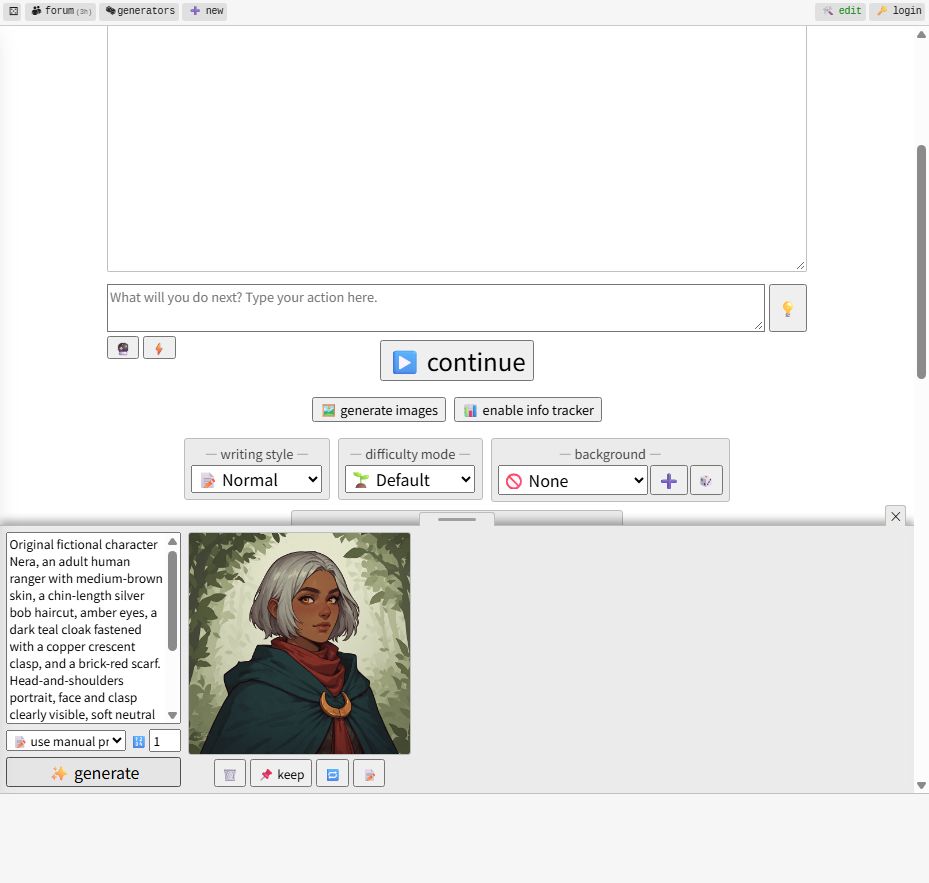
| Forest | Silver bob, brown skin, teal cloak, red scarf, copper crescent | Amber eyes ambiguous; screenshot only | 2026-10-16 · Perchance AI RPG |
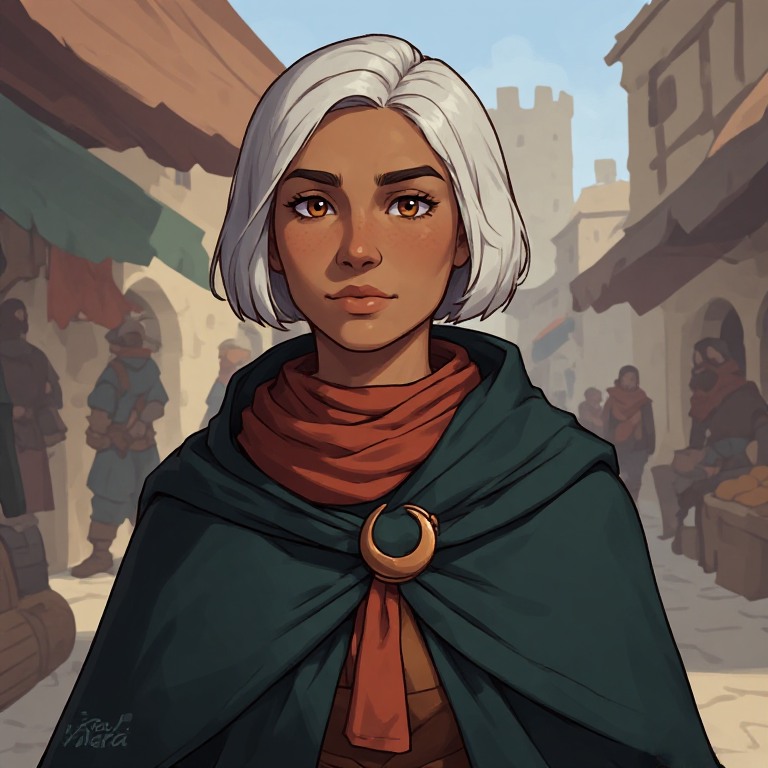
| Market | Same broad descriptors; visible amber eyes | Rounder clasp; frontal view; lower-left marks | 2026-10-16 · Perchance AI RPG |
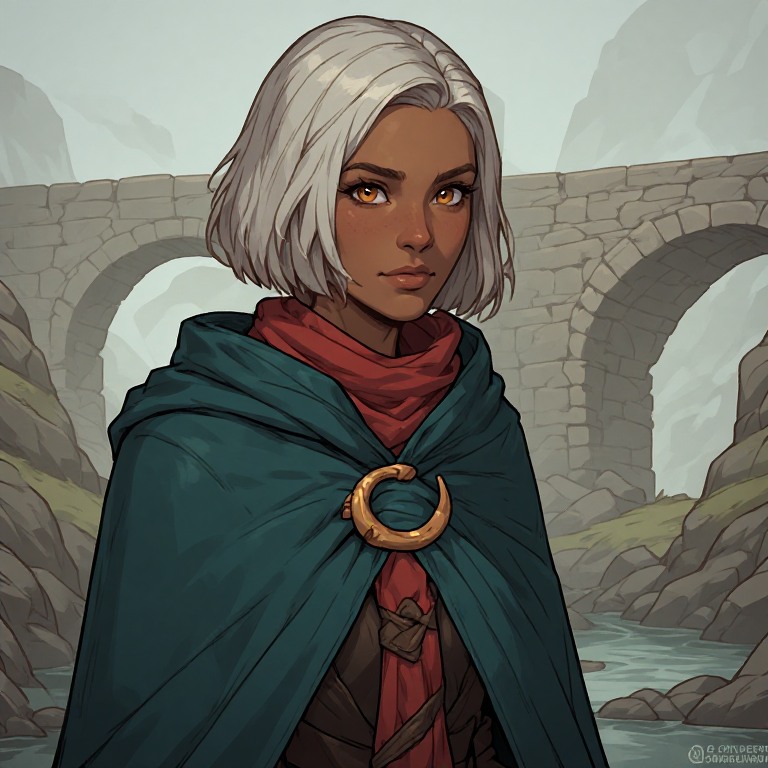
| Bridge | Same broad descriptors; visible amber eyes | More torso; wider crescent; lower-right marks | 2026-10-16 · Perchance AI RPG |
Download the observation table (CSV)
Forest: a retained screenshot
The forest result placed Nera at a three-quarter angle against pale foliage, with leaves framing the top and sides. The silver bob ended around the jaw, with a darker section near the neck. Medium-brown skin, the dark teal cloak and the brick-red scarf were visible. A copper-colored crescent fastened the cloak below the scarf. Those five broad descriptors matched the brief. The eyes were too small in the retained screenshot to certify amber irises, so that attribute remains ambiguous. The composition included more torso than a tight head-and-shoulders crop. Only the original browser screenshot survived export; its small portrait cannot support fine facial measurements.
Market: clearer eyes, different framing
The market output faced the viewer more directly and enlarged the face relative to the forest screenshot. Its silver bob parted near the middle and curved inward at the jaw. Amber-colored irises were visible in the saved original, along with medium-brown skin, a dark teal cloak and a reddish scarf layered around the neck. The copper-colored fastening was much rounder than the forest crescent, with a narrow opening near the top and teal fabric visible inside it. It still met our broad crescent descriptor, but it was not an identical accessory drawing. Stalls, figures and buildings filled the background. Signature-like marks appeared at the lower left despite the instruction excluding lettering and watermarks.
Bridge: the accessory changed again
The bridge output returned to a three-quarter face view. Silver hair, medium-brown skin, amber-colored eyes, the teal cloak and the red scarf were visible in the original image. The clasp was an open, upward-pointing copper-colored crescent, wider and more clearly separated at its tips than the market fastening. A stone bridge with arches crossed the background, and water appeared beside the character. The crop extended down to a belt and pouch, rather than stopping at the shoulders. Small pale, text-like marks appeared at the lower right. We did not interpret those marks as a real signature, nor remove them from the evidence. The scene instruction changed the setting without retaining identical framing.
What this sequence actually distinguishes
Across these retained outputs, the repeated clothing palette and silver bob remained recognizable while their drawn details varied. The market face was frontal; forest and bridge views turned sideways. The cloak folds, scarf arrangement and crescent outline differed. These are visible changes, not a measured face-identity failure. The forest screenshot has lower usable detail than the two original JPEGs, making a symmetrical eye-color judgment impossible. The bridge image also exposed additional clothing below the requested portrait crop. This sequence therefore supports separating descriptor continuity, accessory geometry and composition, instead of treating a matching teal cloak as proof of an identical character face.
Exact brief and method
Original fictional character Nera, an adult human ranger with medium-brown skin, a chin-length silver bob haircut, amber eyes, a dark teal cloak fastened with a copper crescent clasp, and a brick-red scarf. Head-and-shoulders portrait, face and clasp clearly visible, soft neutral daylight, painterly fantasy illustration. Preserve the same identity and clothing. No lettering or watermark.
Append exactly one scene sentence: Background: a leafy forest clearing. / Background: an outdoor medieval market. / Background: an old stone bridge over a river.
We selected manual prompt mode and a batch size of 1, submitting each scene once. We did not supply a reference portrait, select a seed or change a model. The inspected image tray did not identify a model. Saved inputs and first outputs were retained after a browser-control interruption; we did not regenerate missing exports. Ratings describe visible matches, visible mismatches, or ambiguous details. Lighting and occlusion are not automatically mismatches.
What the reference pages cover
AI Dungeon’s picture guide explains See mode, prompt composition and image options. FableAI’s memory guide describes narrative context layers. We borrowed the separation of subject and background as a testing structure, without copying their examples. Neither inspected guide supplies this Nera three-scene record. That is a bounded information addition, not a claim of worldwide exclusivity or missing product functionality.
Does matching the prompt prove the same face?
No. Our attribute checklist checks a description, not biometric identity. A stricter next experiment should preserve the same framing and compare a reference-image workflow with this text-only baseline. That experiment has not been run. These three outputs cannot establish reliability rates, a winner between services, or long-campaign visual memory.